Wand · Style 02
Where the neck flexes
The blunt tail gives the ballast a home. Does the low, narrow transition behind the pitch pivot concentrate the load?
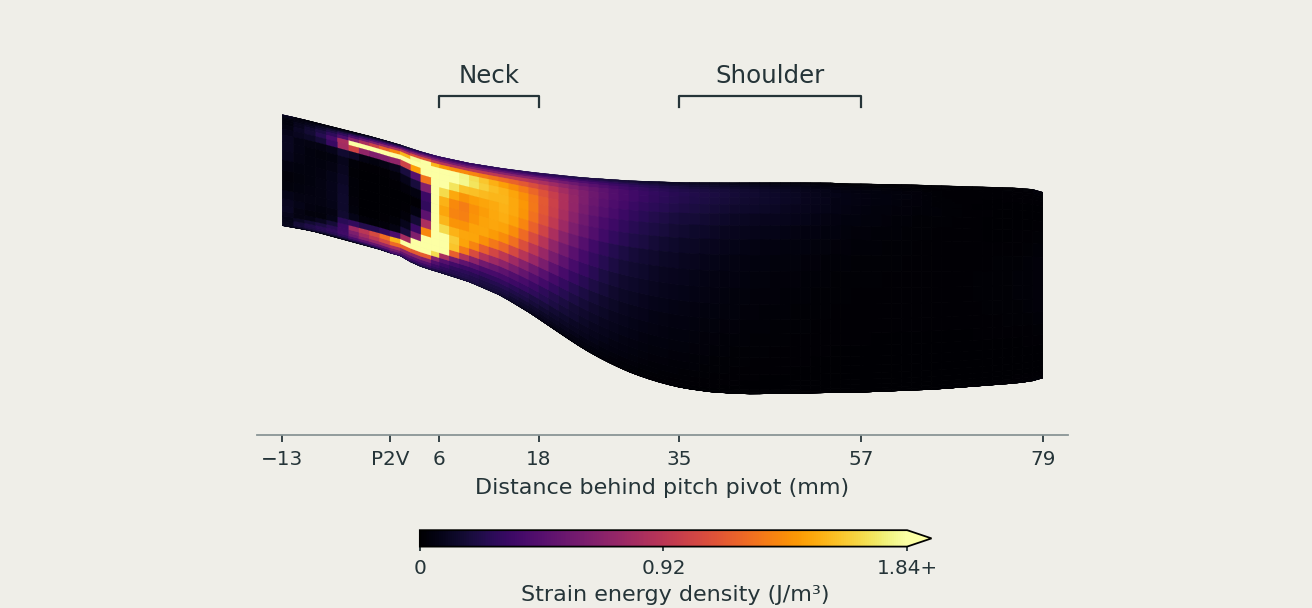
Side view of the undeformed local shell. Brighter cells store more elastic energy per unit volume. Values above 1.84 J/m³ share the brightest colour (98.5th percentile).
Load case
A static 1 N downward load was spread across the ballast spaces. The local model assumes a 0.8 mm laminate shell supported on two pads at the pivot.
- of local strain energy in the neck (6–18 mm)
- 37.6%
- mean energy density versus the shoulder (35–57 mm)
- 14.3×
What the model suggests
The 12 mm neck stores over a third of the elastic energy in the modelled section. The brightest cells touch the support edge, so their intensity depends on how the real pivot transfers load.
A separate model comparison favoured a tapered inner laminate. It reduced both longitudinal and shear strain. Raising the outer profile increased shear strain. A bonded pair of shell halves with the real pivot tube would allow the reinforcement to be tested without changing the silhouette.
The colour scale shows elastic deformation energy. Predicting failure or service life requires the actual laminate, joint properties and load history.